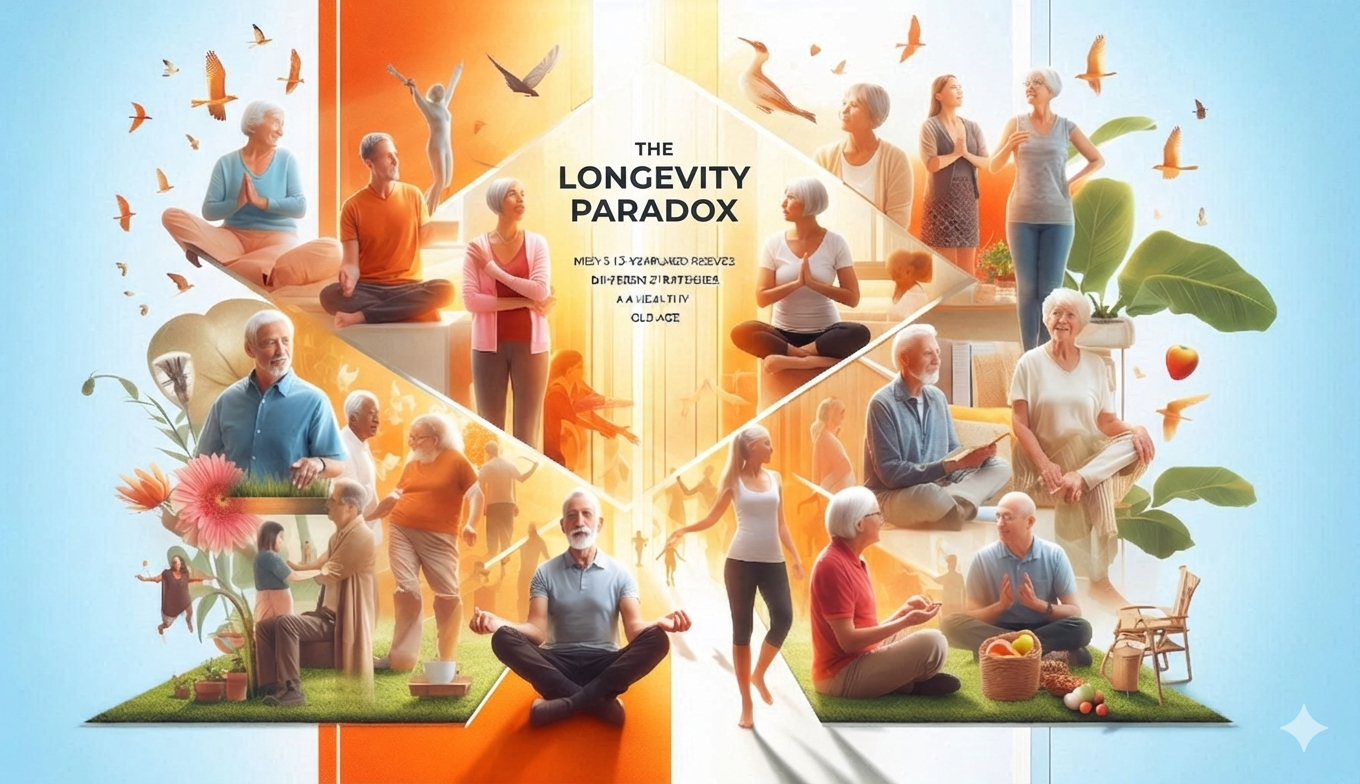
Introduction: The Goal Isn’t Just a Longer Life, It’s a More Independent One
For most of us, the goal of aging isn’t just to live as long as possible, but to live well for as long as possible. The true measure of a quality later life is “functional independence”—the ability to perform daily activities like cooking, shopping, and managing personal care without needing assistance. Maintaining this independence is the cornerstone of healthy aging, allowing us to retain our dignity and control over our lives.
However, a well-documented phenomenon known as the “male–female health-survival paradox” presents a counter-intuitive reality. While women consistently have a longer total life expectancy than men, research shows they often spend a greater proportion of those extra years in a state of dependency. This paradox means that for millions of women, their extra years of life are spent not in active enjoyment, but in a state of vulnerability, which challenges their autonomy and strains family and social care systems.
A major 13-year study involving nearly 12,000 older adults in China now offers profound new insights into this paradox. The findings, published in The Lancet Public Health, reveal that the pathways to a long and independent life are surprisingly different for men and women, challenging the one-size-fits-all approach to healthy aging.
Four Surprising Truths About Staying Independent Longer
By tracking participants for over a decade, the study uncovered four truths that challenge our conventional wisdom about aging—and offer a new, sex-specific roadmap for staying independent longer.
Takeaway 1: Women Live Longer, But Men Live More Years Without Needing Help
The study data clearly illustrate the foundational paradox. At age 65, Chinese women could expect to live longer than men, with a total life expectancy of 18.18 years compared to 15.50 years for men.
However, when looking at independent life expectancy—the years spent free from dependency—the roles were reversed. Men had a longer independent life expectancy of 11.29 years, while women had just 10.35 years. This gap has a profound real-world impact: on average, women spent a staggering 7.83 years in a state of dependency, nearly double the 4.21 years spent by men.
Takeaway 2: For Men, Healthy Habits Are the Strongest Predictor of Independence
The research identified different primary drivers of independent longevity for men and women. For men, the most significant benefits came directly from healthy lifestyle factors, which the study defined as diet, physical activity, smoking, and alcohol use.
The results were striking. Men who adopted 3-4 healthy lifestyle factors gained an average of 2.45 years of independent life compared to men who had only 0-1 healthy habits. This gain was significantly greater than the benefit women saw from lifestyle factors alone. The study suggests these habits act as a primary defence, helping men prevent the initial loss of independence in the first place.
Takeaway 3: For Women, Social Conditions and Support Are More Powerful
In direct contrast, the study found that women’s independent longevity was more strongly influenced by favourable “social determinants of health.” This category included factors like financial status, education level, access to quality health care, built environment (such as quality of housing), and social context (such as being married and having regular social contact).
Women who had 4-5 favourable social factors gained 1.95 years of independent life compared to women with only 0-1. This gain was significantly larger than the 1.67 years observed in men who had similarly positive social conditions. In contrast to lifestyle habits, strong social support systems appear to be most powerful in helping women recover their independence after a health setback and survive longer once they are already in a dependent state.
Pathways to healthy aging differ between sexes in China: males benefit more from lifestyle modifications, whereas females gain more from improved social conditions.
Takeaway 4: The Ultimate Boost Comes from Combining Both
While lifestyle was key for men and social conditions for women, the study revealed a powerful synergistic effect when both were combined. For both sexes, having both a healthy lifestyle and favourable social support produced the largest improvement in independent life expectancy.
This combination led to a gain of 3.94 years of independent life for men and 3.89 years for women, compared to those with the lowest levels of both lifestyle and social factors. This demonstrates that personal responsibility (lifestyle) and societal support (social conditions) are not opposing forces but are deeply intertwined, and that true progress in healthy aging requires action on both fronts simultaneously.
Conclusion: Redrawing the Map for a Healthier, More Independent Future
The core message of this comprehensive study is clear: a “one-size-fits-all” approach to promoting healthy aging is not enough. To be effective, public health strategies must be sex-specific. The findings suggest a focus on reducing unhealthy behaviours like smoking and drinking among men, while simultaneously working to improve financial security, health-care access, and social support systems for women.
Yet, the study leaves us with a final, grave challenge. While these factors extend the years of independence, they do not yet achieve a “compression of dependency”—meaning the proportion of one’s total life spent needing care is not yet shrinking. The hard truth is that gains in life expectancy are not always accompanied by proportional gains in healthy years. As our populations live longer, the duration of dependency may be growing, creating a looming crisis for individuals, families, and healthcare systems. This highlights the urgent need for strategies that don’t just add years to life, but add healthy, independent years to life.
Knowing that the keys to a long and independent life can be so different, how should we rethink not only our personal health choices but also the ways our communities support men and women as they age?